Navigating Shocks: The Ripple Effects of Shipping Route Closures
with Carsten Philipp Brockhaus and Charles Serfaty. Banque de France Working Paper, 1057, August 2026.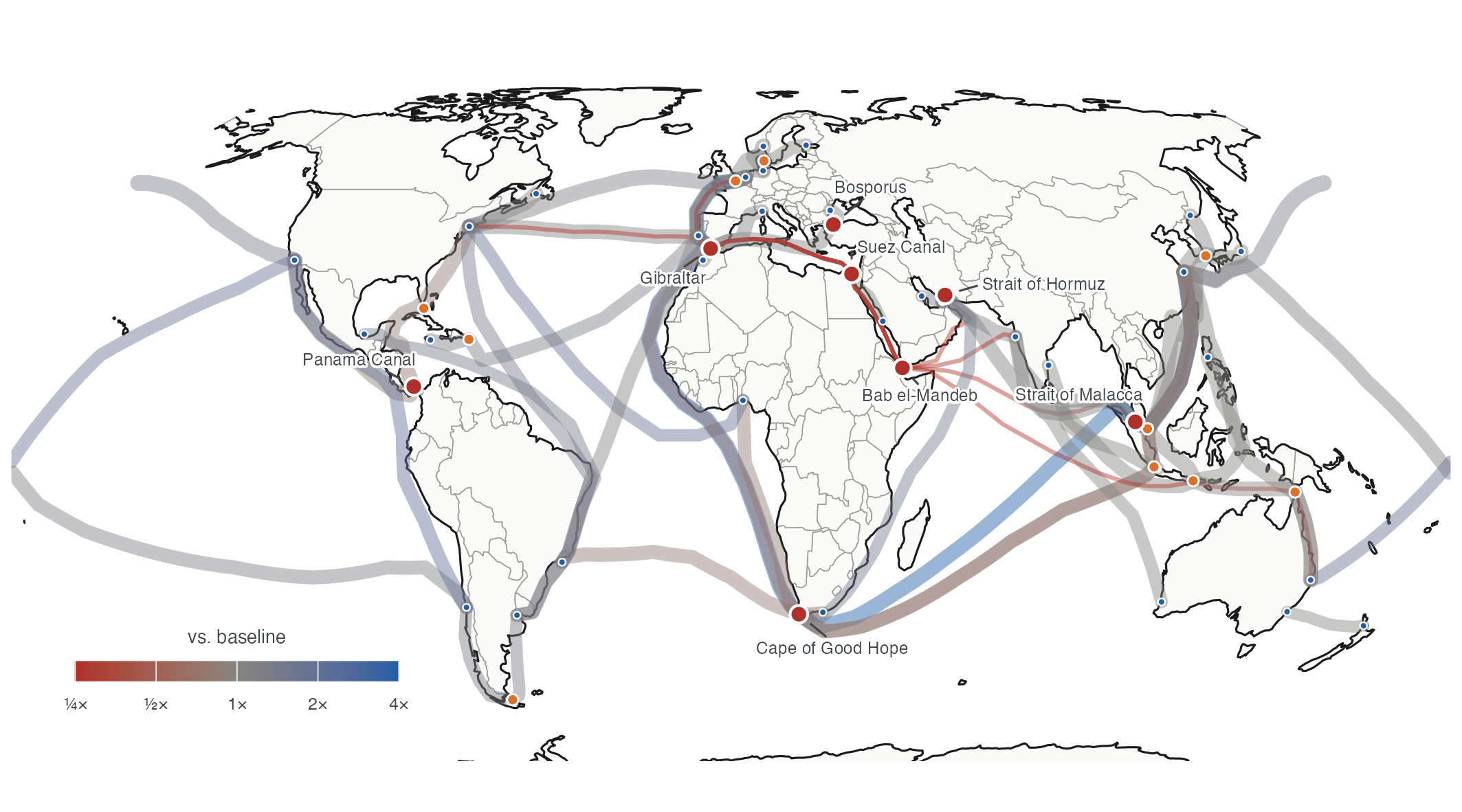
Rerouting of global shipping under a Red Sea closure: traffic shifts from the Suez Canal to the Cape of Good Hope.
Who bears the cost when a maritime chokepoint is disrupted? Combining ship-level AIS trajectories, port-call logs, freight indices, customs data and Turkish shipment-level data, we document the trade effects of the 2023 Red Sea crisis: seaborne trade between affected country pairs fell, rerouted around the Cape of Good Hope, and recovered within months as freight costs surged, while some exporters shifted persistently toward air freight.
We build a quantitative trade model in which freight costs are endogenous to modal and route choice through congestion, a global shipping capacity constraint, and monopoly toll-setting by canal authorities. Calibrated to observed route choices and canal revenues, the model implies that a permanent Red Sea closure lowers global real income only mildly. Because the Suez Canal Authority, pricing to maximize revenue, already captures much of the route’s surplus, the loss falls on the toll collector: Egypt forgoes 3.0 percent of real income, almost all of it canal rent, while the large trading economies each lose less than 0.02 percent.
A transit fee on the Strait of Hormuz, a chokepoint without maritime substitutes, instead concentrates losses on the Gulf economies themselves. Whether a chokepoint has substitutes, and who prices it, jointly determine who pays for its disruption.
Links & Downloads
Presentations
- 2026-06-16 “Navigating Shocks: The Ripple Effects of Shipping Route Closures” — Research Seminar, RWTH Aachen Slides